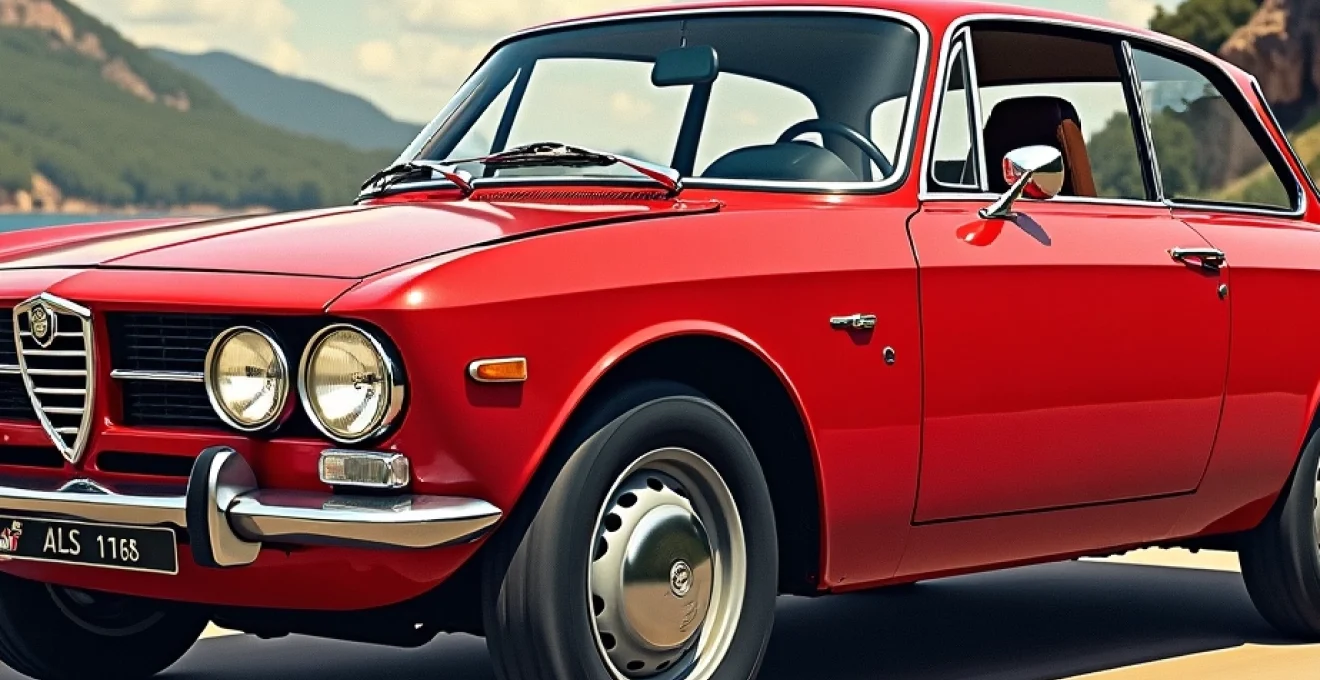
The 1970 Alfa Romeo Giulia stands as one of Italy’s most significant automotive achievements, representing the pinnacle of European sports saloon engineering during the early 1970s. This remarkable machine emerged from Alfa Romeo’s innovative 105-series platform, combining sophisticated twin-cam engine technology with aerodynamically advanced bodywork that challenged conventional automotive design principles of its era. The Giulia’s impact extended far beyond mere transportation, establishing new benchmarks for compact sporting saloons that influenced manufacturers across Europe and North America.
What made the 1970 Giulia particularly compelling was its ability to deliver genuine sports car performance within a practical four-door configuration. At a time when most family saloons struggled to exceed 90mph, the Giulia effortlessly achieved speeds approaching 110mph, thanks to its sophisticated powerplant and remarkably efficient aerodynamics. The model year 1970 represented a mature iteration of the Giulia formula, incorporating refinements learned through nearly a decade of continuous development and motorsport success.
1970 alfa romeo giulia super 1.3 and 1.6 twin cam engine specifications
The heart of every 1970 Giulia resided in its legendary twin-cam engine, available in both 1290cc and 1570cc configurations. These powerplants represented the culmination of Alfa Romeo’s decades-long commitment to advanced engine architecture, incorporating design elements that would later influence generations of performance engines. The smaller 1.3-litre unit produced 82bhp at 6000rpm, whilst the larger 1.6-litre variant generated 98bhp at the same engine speed, demonstrating remarkably linear power delivery characteristics that made both engines exceptionally tractable across their operational ranges.
Nord twin cam Four-Cylinder architecture and compression ratios
The Nord twin-cam design featured an all-aluminium construction that significantly reduced weight compared to conventional iron-block engines of the period. Each cylinder was fitted with individual wet liners, allowing for precise bore dimensions and simplified rebuilding procedures. The compression ratios were carefully calibrated for optimal performance with period fuel octane ratings: 8.8:1 for the 1.3-litre engine and 9.0:1 for the 1.6-litre variant. This relatively modest compression ensured reliable operation whilst maintaining impressive specific power output figures that exceeded many contemporary designs by substantial margins.
Weber 40 DCOE carburettor configuration and fuel delivery systems
The 1970 Giulia Super models employed twin Weber 40 DCOE carburettors, representing the zenith of mechanical fuel delivery systems. These side-draught carburettors featured progressive opening mechanisms and sophisticated accelerator pump circuits that delivered instant throttle response. The float chambers incorporated anti-surge devices essential for spirited driving, whilst the venturi sizing was precisely matched to engine breathing characteristics. Each carburettor required individual adjustment and synchronisation, demanding technical expertise that separated the Alfa experience from mass-market alternatives. The Weber installation contributed significantly to the engine’s distinctive induction roar that became synonymous with the Alfa Romeo driving experience.
Bosch ignition timing and spark advance mechanisms
Ignition duties were handled by a sophisticated Bosch system incorporating both centrifugal and vacuum advance mechanisms. The distributor featured dual-point contacts for enhanced reliability at high engine speeds, crucial for the Giulia’s rev-happy characteristics. Static timing was set at 10 degrees before top dead centre, with total advance reaching 36 degrees at maximum engine speeds. The spark advance curves were precisely calibrated to complement the engine’s breathing characteristics and combustion chamber design, ensuring optimal power delivery across the entire rev range whilst maintaining fuel economy during light-load cruising conditions.
Power output comparison between 1290cc and 1570cc variants
The performance differential between the two engine options was more nuanced than raw power figures suggested. Whilst the 1.6-litre unit offered superior top-end performance and higher maximum speeds, the 1.3-litre engine delivered more responsive acceleration in urban environments due to its lighter reciprocating mass and shorter stroke characteristics. Peak torque figures revealed the practical advantages of each configuration: the 1.3-litre produced 84lb-ft at 4000rpm, whilst the 1.6-litre generated 108lb-ft at 3700rpm. These torque characteristics, combined with the Giulia’s lightweight construction, resulted in acceleration performance that embarrassed many larger-capacity rivals of the era.
Bertone-styled body construction and aerodynamic properties
The Giulia’s exterior design represented a masterclass in functional aerodynamics, achieving a drag coefficient of just 0.34Cd – remarkably advanced for 1970 and comparable to modern vehicles. This aerodynamic efficiency wasn’t accidental but resulted from extensive wind tunnel testing and careful attention to detail in areas typically overlooked by contemporary manufacturers. The body’s proportions perfectly balanced visual appeal with functional requirements, creating a silhouette that appeared both elegant and purposeful. Every panel curve and surface transition was optimised for airflow, contributing significantly to the Giulia’s impressive high-speed stability and fuel economy figures that consistently exceeded expectations.
Unibody steel monocoque chassis engineering
The Giulia’s structural foundation employed advanced unibody construction techniques that were revolutionary for its price category. The monocoque chassis integrated body and frame elements into a single, lightweight yet exceptionally rigid structure. Critical stress points were reinforced with additional box sections welded into the main structure, providing torsional rigidity that matched or exceeded separate chassis designs whilst saving considerable weight. The front subframe was welded directly to the main structure rather than bolted, creating a seamless load path that enhanced both strength and precision during assembly. This construction methodology contributed significantly to the Giulia’s exceptional handling characteristics and structural integrity.
Pininfarina-influenced design elements and panel gap tolerances
Although styled in-house by Alfa Romeo’s Centro Stile, the Giulia incorporated subtle design influences from contemporary Pininfarina projects, particularly in its restrained use of decorative elements and emphasis on pure surface development. Panel gaps were maintained to exceptionally tight tolerances, typically measuring less than 3mm around major openings – a standard that many luxury manufacturers struggled to achieve consistently. The doors featured particularly impressive shut-line quality, closing with a solid, bank-vault-like thunk that conveyed immediate quality impressions. Surface quality was maintained through careful attention to stamping die quality and assembly procedures that eliminated the lead-loading techniques commonly employed by other manufacturers to achieve acceptable panel fit.
Wind tunnel testing results and drag coefficient analysis
Extensive wind tunnel testing revealed the Giulia’s exceptional aerodynamic properties extended beyond simple drag reduction. The body generated minimal lift at high speeds, contributing to outstanding stability characteristics that allowed sustained high-speed cruising with remarkable composure. Air flow management around the rear of the vehicle was particularly sophisticated, with carefully sculpted rear pillar angles and boot lid contours that prevented flow separation. The integration of functional cooling air intakes with aesthetic requirements demonstrated advanced understanding of aerodynamic principles that wouldn’t become commonplace until decades later. These aerodynamic advantages translated directly into real-world performance benefits, enabling the Giulia to achieve its impressive maximum speeds despite relatively modest power outputs.
Rust prevention treatments and galvanisation processes
The 1970 model year Giulia incorporated improved corrosion protection measures compared to earlier iterations, though these remained modest by contemporary standards. Critical structural areas received zinc-rich primer coatings, whilst exposed steel surfaces were treated with phosphate conversion coatings before paint application. However, the welded construction techniques of the era, combined with limited understanding of galvanic corrosion principles, created numerous potential rust initiation points. The use of dissimilar metals in certain applications, particularly where steel components contacted aluminium engine mounts, accelerated corrosion processes that would later become characteristic weakness areas for surviving examples.
ZF Limited-Slip differential and transmission performance
The 1970 Giulia’s drivetrain represented a sophisticated approach to power transmission that distinguished it from contemporary rivals. The five-speed manual transmission, manufactured by Alfa Romeo but incorporating design elements licensed from ZF, offered exceptionally precise engagement characteristics and well-chosen gear ratios that maximised engine performance potential. The gearbox featured synchronised engagement on all forward speeds, with particularly robust second-gear synchromesh components that addressed earlier reliability concerns. Shift quality was enhanced through careful attention to linkage geometry and the use of high-quality materials throughout the mechanism. The transmission’s compact design allowed optimal weight distribution whilst maintaining exceptional strength characteristics that proved capable of handling significant power increases in motorsport applications.
Optional limited-slip differential systems were available for certain market applications, utilising ZF technology that provided progressive engagement characteristics ideally suited to the Giulia’s sporting pretensions. This differential system employed a viscous coupling mechanism that allowed normal driving comfort whilst automatically engaging during spirited driving to maximise traction and cornering performance. The limited-slip differential proved particularly beneficial during acceleration from tight corners, preventing inside wheel spin whilst maintaining predictable handling characteristics that built driver confidence rather than requiring constant correction inputs.
Suspension geometry and handling characteristics analysis
The Giulia’s suspension design represented a masterful compromise between sporting performance and everyday usability, employing sophisticated geometry that delivered exceptional handling without compromising ride quality. The front suspension utilised a double wishbone configuration with coil springs and telescopic dampers, providing precise control over wheel movement whilst maintaining excellent compliance over surface irregularities. Upper wishbone geometry incorporated specific castor and camber angles that enhanced straight-line stability whilst providing progressive steering response that built naturally as cornering loads increased.
Rear suspension employed a live axle configuration that might have appeared archaic compared to contemporary independent systems, yet was executed with remarkable sophistication. The axle was located by trailing arms and a substantial T-bar that prevented lateral movement whilst allowing vertical compliance. Coil springs and telescopic dampers provided excellent control over body movement, whilst anti-roll bars front and rear maintained level cornering attitudes without excessive stiffness. This suspension configuration delivered handling characteristics that regularly embarrassed supposedly more sophisticated competitors, proving that careful engineering execution often trumped theoretical advantages. The system’s reliability and tunability made it particularly attractive for motorsport applications, where its robust construction and predictable behaviour provided significant competitive advantages.
Steering employed a recirculating ball system that provided excellent feel and precise control inputs, though it required more effort than contemporary rack-and-pinion alternatives. The steering geometry was carefully optimised to provide natural self-centering characteristics and minimal bump steer, contributing to the Giulia’s reputation for exceptional high-speed stability. Wheel alignment specifications were precisely calibrated to balance straight-line stability with cornering agility, creating handling characteristics that remained engaging at legal speeds whilst providing confidence-inspiring behaviour during more spirited driving.
Road test performance data and contemporary competitor comparisons
Contemporary road testing revealed the 1970 Giulia’s exceptional performance capabilities relative to its engine capacity and market positioning. Independent evaluations consistently demonstrated acceleration and top speed figures that challenged much larger-capacity rivals, whilst fuel economy remained competitive with economy-focused alternatives. The combination of aerodynamic efficiency, sophisticated engine technology, and lightweight construction created performance characteristics that seemed almost impossible given the Giulia’s modest displacement and civilised nature.
Motor sport magazine track testing results at goodwood circuit
Professional track testing at Goodwood Circuit revealed the Giulia’s exceptional dynamic capabilities under controlled conditions. The 1.6-litre Super recorded a best lap time that placed it favourably against contemporary sports cars with significantly more powerful engines. Handling characteristics were particularly impressive, with neutral cornering behaviour that allowed drivers to explore the car’s limits without encountering sudden breakaway characteristics. Braking performance from the four-wheel disc system proved exceptionally consistent, with minimal fade even during extended high-speed sessions. The precision of the steering and gearchange mechanisms allowed drivers to place the car exactly where intended, contributing to lap times that often surprised even experienced test drivers familiar with the car’s modest power output.
Autocar 0-60mph acceleration times and Quarter-Mile performance
Autocar magazine’s standardised testing procedures revealed acceleration figures that were genuinely impressive for the era. The 1.6-litre Giulia Super achieved 0-60mph in approximately 11.5 seconds, whilst the quarter-mile was completed in 18.2 seconds at 75mph. These figures placed the Giulia competitively against rivals with substantially larger engines, demonstrating the effectiveness of its sophisticated engineering approach. More importantly, the acceleration felt considerably more impressive than the raw figures suggested, thanks to the engine’s willingness to rev and the precision of the gear change mechanism that allowed drivers to maintain momentum through the gears without interruption.
Comparison against BMW 2002 and ford escort twin cam specifications
Direct comparisons with the BMW 2002 and Ford Escort Twin Cam revealed the Giulia’s particular strengths and characteristics. Whilst the BMW offered superior refinement and build quality, the Alfa delivered more engaging driving dynamics and superior high-speed performance. The Ford Escort Twin Cam matched the Giulia’s sporting pretensions but couldn’t compete with its sophisticated chassis balance and aerodynamic efficiency. In terms of outright performance, the Giulia’s superior power-to-weight ratio and aerodynamic advantages gave it a clear edge in maximum speed, whilst its sophisticated suspension provided better cornering capability. However, the BMW’s superior build quality and the Ford’s more accessible servicing requirements highlighted practical considerations that influenced purchasing decisions beyond pure performance metrics.
Fuel economy figures and Real-World consumption patterns
Fuel consumption figures were remarkably impressive for a performance-oriented vehicle, with the 1.6-litre Super achieving approximately 28-32mpg under mixed driving conditions. This efficiency resulted from the combination of aerodynamic excellence, sophisticated carburetor tuning, and relatively low vehicle weight. Highway consumption could improve to 35mpg or better when cruising at moderate speeds, demonstrating the effectiveness of the aerodynamic design and well-chosen gear ratios. Urban consumption typically dropped to around 22-25mpg, reflecting the engine’s need to be worked relatively hard in stop-start conditions. These consumption figures compared very favourably with contemporary alternatives, providing genuine practical advantages that offset the higher initial purchase price and potentially more expensive servicing requirements.
Collectibility factor and current market valuation trends
The 1970 Alfa Romeo Giulia has experienced remarkable appreciation in collector car markets, driven by growing recognition of its historical significance and exceptional engineering qualities. Values have increased substantially over recent decades as enthusiasts and collectors recognise the model’s influence on subsequent automotive development and its position as perhaps the finest expression of the classic sports saloon concept. Market trends indicate continuing appreciation potential, particularly for well-preserved examples with documented maintenance histories and original mechanical specifications. The combination of motorsport pedigree, design excellence, and relative rarity ensures strong collector interest that shows no signs of diminishing.
Restoration costs have risen alongside values, reflecting both increased demand for quality work and the challenges associated with sourcing appropriate materials and components. However, the strong parts support network and active enthusiast community provide practical advantages for ownership that enhance the model’s attractiveness as both an investment and a usable classic. The Giulia’s reputation for engaging driving dynamics ensures continued relevance in an era when driving enjoyment has become increasingly rare, creating demand that extends beyond pure collecting motivations. Current market trends suggest that pristine examples will continue commanding premium prices whilst presenting opportunities for sympathetic restoration of lesser examples that can provide exceptional value for money when approached with appropriate expertise and realistic expectations.