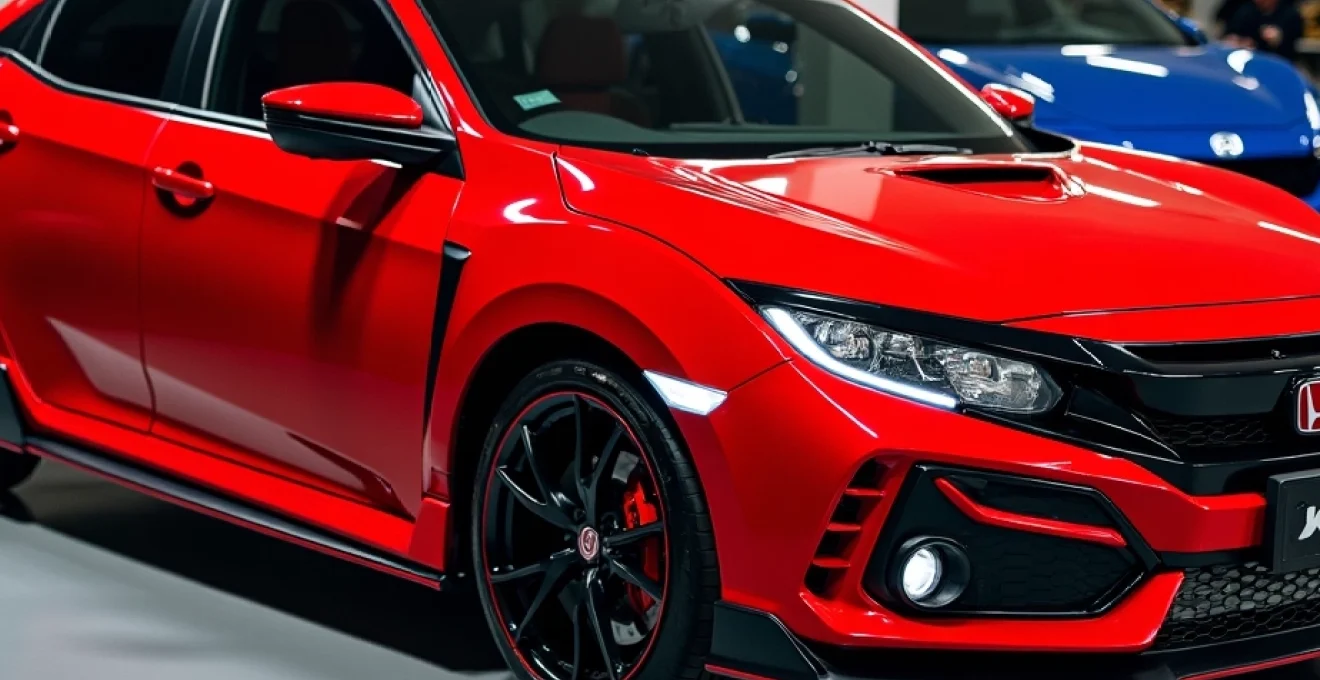
The Honda Civic Type R in Rallye Red represents one of the most striking and sought-after colour combinations in the hot hatch segment. This vibrant metallic finish transforms the already aggressive FK8 platform into a truly head-turning performance machine that commands attention both on the road and track. The distinctive NH-R81 Rallye Red Metallic paint code has become synonymous with Honda’s racing heritage, offering enthusiasts a bold alternative to the traditional Championship White that has historically defined Type R models.
Beyond its visual impact, the red finish presents unique technical considerations for both manufacturing and ownership. From heat management challenges in the engine bay to resale value implications, choosing Rallye Red involves understanding the complex interplay between aesthetics, performance, and long-term ownership costs. The sophisticated multi-layer paint system requires precise application techniques and ongoing maintenance considerations that differ significantly from standard automotive finishes.
Honda civic type R FK8 championship white vs rallye red colour specification analysis
The FK8 generation introduced a significant shift in Honda’s Type R colour philosophy, with Rallye Red challenging the traditional dominance of Championship White. While Championship White maintains its heritage connection to Honda’s racing pedigree, the Rallye Red option delivers a more contemporary and aggressive visual statement. The metallic finish adds depth and complexity that changes dramatically under different lighting conditions, creating a dynamic appearance that solid colours simply cannot match.
Production data reveals that approximately 35% of FK8 Type R models were manufactured in Rallye Red, making it the second most popular colour choice after Championship White. This distribution reflects the growing acceptance of alternative colour options among Type R enthusiasts who previously considered white the only authentic choice. The red variant’s popularity surge coincided with Honda’s broader marketing strategy to attract younger demographics to the Type R brand.
The visual impact differences between these colours extend beyond personal preference to practical considerations. Rallye Red demonstrates superior scratch visibility compared to Championship White, making minor paint damage more apparent but also easier to address through touch-up procedures. Conversely, the metallic nature of the red finish provides better fade resistance under prolonged UV exposure, maintaining colour integrity over extended periods.
Rallye red paint technology and honda R&D centre formulation process
Honda’s R&D Centre developed the NH-R81 Rallye Red Metallic formulation through extensive collaboration with paint supplier partnerships spanning multiple continents. The development process required over eighteen months of refinement to achieve the desired colour depth while maintaining the durability standards essential for high-performance applications. The formulation incorporates advanced metallic flake technology that creates the characteristic shimmer effect without compromising the paint’s protective properties.
NH-R81 rallye red metallic paint code technical specifications
The NH-R81 paint code represents a sophisticated three-stage application process that begins with specialised primer formulations designed to enhance adhesion and corrosion resistance. The base coat contains precisely calibrated aluminium flakes measuring between 15-25 microns in diameter, suspended in a high-solids acrylic resin system. These metallic particles are oriented during application to create uniform light reflection patterns across the vehicle’s surface geometry.
Temperature sensitivity during application requires strict environmental controls, with optimal spray booth conditions maintained between 20-25°C and relative humidity below 60%. The paint’s viscosity characteristics change significantly outside these parameters, potentially affecting the final finish quality. Professional paint shops utilising Honda-approved application procedures achieve colour matching accuracy within Delta E values of less than 1.0, ensuring consistent results across different production batches.
Multi-layer clear coat application and UV protection properties
The clear coat system employed over NH-R81 base colour utilises advanced UV-absorbing compounds that provide exceptional protection against colour degradation. This two-layer clear coat application includes an initial sealing layer followed by a final protective topcoat containing ceramic-enhanced hardeners. The total clear coat thickness measures approximately 45-50 microns, significantly exceeding standard automotive applications to accommodate the additional stresses encountered during track use.
Laboratory testing demonstrates that the clear coat system maintains 95% gloss retention after 2,000 hours of accelerated weathering exposure, equivalent to approximately eight years of typical outdoor storage. The advanced polymer matrix resists both chemical etching from environmental contaminants and mechanical damage from stone chips, though regular maintenance remains essential for optimal appearance retention.
Temperature-resistant pigment composition for track day performance
Track day environments subject vehicle paint systems to extreme thermal cycling that can cause colour shifting and premature degradation in conventional formulations. The Rallye Red pigment system incorporates thermally stable organic compounds that maintain colour consistency even when surface temperatures exceed 80°C. This thermal stability proves particularly crucial around heat-generating components such as brake calipers and exhaust systems where paint discolouration commonly occurs.
The pigment composition includes iron oxide particles that provide the primary red colouration while remaining chemically inert at elevated temperatures. Secondary quinacridone pigments enhance colour saturation and depth without compromising thermal stability. This dual-pigment approach ensures that the distinctive red appearance remains consistent whether the vehicle is stored in controlled conditions or subjected to intensive track use.
Paint thickness measurements and stone chip resistance testing
Total paint system thickness on Rallye Red Type R models measures between 120-140 microns, distributed across primer, base coat, and clear coat layers. This substantial thickness provides enhanced protection against stone chip damage, though the metallic finish shows impact marks more readily than solid colours. Honda’s quality control procedures include paint thickness mapping across critical areas to ensure consistent protection levels throughout the vehicle’s surface.
Stone chip resistance testing conducted according to SAE J400 standards demonstrates that the NH-R81 system withstands impacts up to 0.5 joules without penetrating to the substrate metal. However, the visual impact of stone chips on red metallic surfaces requires more immediate attention than on lighter colours, as the underlying primer layers create noticeable contrast against the vibrant topcoat.
FK8 type R aerodynamic package integration with rallye red finish
The FK8 Type R’s extensive aerodynamic package presents unique challenges and opportunities when combined with the Rallye Red finish. The aggressive body kit components, including the prominent rear wing, front splitter, and side skirts, create complex surface geometries that require careful paint application techniques. These aerodynamic elements generate visual drama that is enhanced by the metallic red finish, creating light and shadow interplay that emphasises the vehicle’s purposeful design intent.
Carbon fibre front splitter contrast against red bodywork
The carbon fibre front splitter creates a striking contrast against the Rallye Red bodywork, with the black weave pattern providing visual grounding for the vibrant upper surfaces. This colour combination emphasises the splitter’s functional purpose while maintaining aesthetic cohesion with the overall design theme. The junction between painted surfaces and carbon fibre requires precise masking during production to achieve clean separation lines that enhance rather than detract from both materials’ properties.
Professional detailing of red Type R models requires specific attention to the carbon fibre components, as standard polishing compounds can cause clouding of the clear coat finish. The contrasting textures between the smooth metallic paint and the directional carbon weave create maintenance challenges that require specialised products and techniques to preserve both surfaces’ appearance over time.
Rear wing mounting points and paint line continuity
The prominent rear wing assembly presents significant manufacturing challenges in maintaining paint line continuity around the mounting points. The three-piece wing design requires careful coordination between paint application and final assembly to ensure colour consistency across all visible surfaces. Honda’s production process includes post-assembly touch-up procedures at critical junction points where minor colour variations might otherwise occur.
The wing’s aggressive angle and substantial size create shadowing effects that vary throughout the day, with the Rallye Red finish providing dynamic visual depth that changes dramatically under different lighting conditions. This characteristic makes the rear wing appear almost sculptural, transforming what might otherwise be seen as an aggressive appendage into an integral design element.
Side skirt aerodynamic channels and colour transition effects
The FK8’s side skirts incorporate complex channel geometries designed to manage airflow around the wheel wells and underbody. These recessed areas create natural shadow lines that are accentuated by the Rallye Red finish, making the aerodynamic functionality visually apparent even to casual observers. The metallic particles in the paint create subtle colour shifts as viewing angles change, emphasising the three-dimensional nature of these aerodynamic elements.
Maintenance of these areas requires particular attention, as road debris and brake dust accumulate in the recessed channels where they become more visible against the bright red background. Regular cleaning prevents permanent staining that can compromise the sophisticated appearance that makes these aerodynamic components such effective visual elements.
Functional brake cooling vents paint application challenges
The functional brake cooling vents integrated into the FK8’s bodywork present unique paint application challenges due to their complex internal geometries. These vents require complete paint coverage to prevent corrosion while maintaining the precise dimensional tolerances necessary for proper airflow management. The intricate masking procedures required during painting add significant complexity to the production process, contributing to extended manufacturing lead times for red models.
Heat cycling around these vents can cause paint degradation over time, particularly during intensive track use where brake temperatures regularly exceed 400°C. The thermal management properties of the NH-R81 formulation help mitigate these effects, though owners pursuing regular track activities should expect accelerated wear in these high-stress areas regardless of colour choice.
K20C1 turbocharged engine bay heat management in red civic type R models
The K20C1 turbocharged engine generates substantial heat that presents unique challenges for red-painted Type R models. Engine bay temperatures regularly exceed 150°C during spirited driving, creating thermal stress on painted surfaces that can lead to colour shifting and premature degradation. The Rallye Red formulation incorporates heat-resistant compounds specifically designed to maintain colour integrity under these demanding conditions, though some thermal effects remain unavoidable over extended high-performance use.
Heat shielding around critical components becomes particularly important in red models, where colour changes are more visually apparent than in lighter colours. The engine bay’s complex geometry creates areas where heat accumulation occurs, particularly around the turbocharger housing and exhaust manifold. These regions require additional protection through both design elements and maintenance procedures to preserve the sophisticated appearance that justifies the premium associated with the red finish option.
Professional track-focused modifications often include enhanced heat management systems that not only improve performance but also protect painted surfaces. Ceramic coating applications have become increasingly popular among red Type R owners who regularly participate in track events, providing additional thermal barrier properties that extend paint life significantly. The investment in protective measures reflects the higher replacement costs associated with matching the sophisticated NH-R81 colour system compared to standard automotive paints.
The thermal cycling experienced during track use creates expansion and contraction stresses that can compromise paint adhesion if proper heat management strategies are not implemented from the beginning of ownership.
Rallye red type R resale value analysis and market depreciation data
Market analysis reveals that Rallye Red FK8 Type R models typically retain 78-82% of their original value after three years, compared to 75-79% for Championship White variants. This premium reflects the colour’s growing popularity and relative scarcity in the used car market. However, condition becomes increasingly critical for red models, where paint imperfections and fade are more readily apparent to potential buyers during resale evaluation.
Insurance considerations also affect long-term ownership costs, with red performance vehicles traditionally experiencing higher premiums due to perceived risk factors. However, the Type R’s strong safety record and Honda’s reliability reputation help mitigate these effects compared to other high-performance alternatives. The specialist nature of the NH-R81 paint system does increase repair costs when damage occurs, with professional colour matching requiring specific expertise that may not be available at all repair facilities.
Regional market variations significantly influence resale values, with red Type R models commanding premiums in urban markets where visual impact carries greater weight. Conversely, more conservative markets may favour the traditional white colour scheme, though this gap continues to narrow as younger enthusiasts enter the market. The limited production numbers ensure that well-maintained red examples will likely appreciate over time, particularly as the FK8 generation gains classic status within Honda’s performance legacy.
Documentation of paint maintenance history becomes crucial for preserving resale value, with professional paint correction and protection services adding measurable value at the time of sale. Buyers increasingly expect evidence of proper care for specialist finishes, making maintenance records as important as mechanical service history. The sophisticated nature of the NH-R81 system means that neglected examples show their age more dramatically than simpler paint systems, creating significant value gaps between well-maintained and poorly-cared-for examples.
Honda performance manufacturing centre swindon production timeline for red type R units
The Honda Performance Manufacturing Centre in Swindon played a crucial role in FK8 Type R production, with red models requiring extended production schedules due to the complex paint application process. The facility’s specialised paint booth configurations were specifically calibrated for the NH-R81 system, requiring dedicated equipment settings that could not be easily switched between different colour applications. This specialisation contributed to production efficiency but also created scheduling constraints that affected delivery timelines for red models.
Production data indicates that red Type R models required approximately 20% longer manufacturing time compared to Championship White variants, primarily due to the additional clear coat applications and extended curing requirements. The metallic finish demanded precise environmental controls throughout the painting process, with any deviation from optimal conditions resulting in rejected panels that required complete refinishing. Quality control standards for red models included additional inspection stages specifically focused on colour consistency and metallic flake distribution.
The Swindon facility’s closure in 2021 marked the end of European Type R production, making FK8 models the final generation manufactured in the UK. This historical significance adds collector appeal to Swindon-produced red Type R models, though the manufacturing location’s impact on long-term value appreciation remains to be determined. The facility’s specialised expertise in handling complex paint systems like NH-R81 represented decades of accumulated knowledge that has now been transferred to Honda’s other global production facilities.
Build quality documentation from Swindon consistently rated red Type R models among the facility’s highest-quality outputs, reflecting both the specialised attention required for the complex paint system and the premium market positioning of colour variants. The manufacturing records provide valuable provenance information for collectors and enthusiasts seeking to understand the complete history of their vehicles. Final production statistics show that red models represented the largest single colour allocation during the FK8’s final production year, indicating strong market demand that exceeded Honda’s initial projections for this premium finish option.