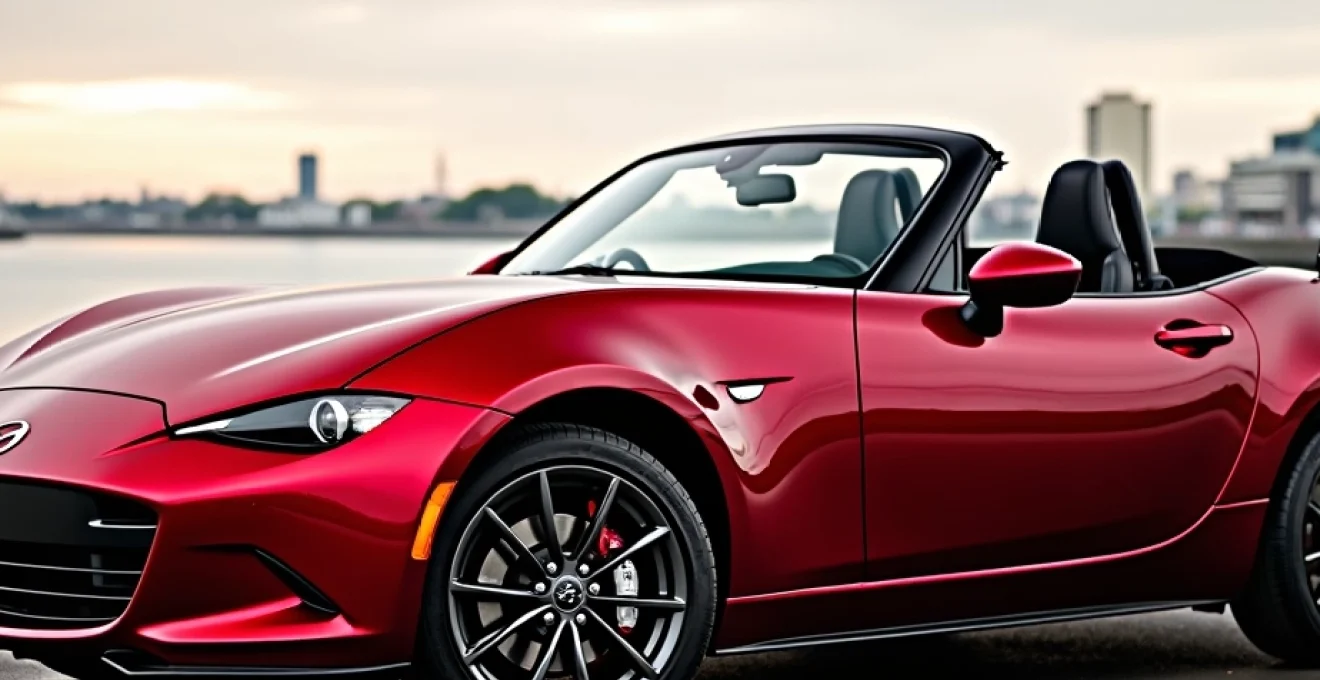
The automotive industry rarely produces vehicles that transcend their mechanical origins to become cultural phenomena. The Mazda MX-5 Miata achieved this distinction within its first decade, establishing itself as the definitive modern interpretation of the classic British roadster formula. By 2014, as the third-generation NC platform prepared for retirement, Mazda celebrated a quarter-century of open-top excellence with the 25th Anniversary Edition—a meticulously crafted tribute that represented the pinnacle of NC development.
This limited-production variant emerged during a pivotal moment in automotive history, when connectivity and digital integration were rapidly transforming vehicle interiors. The 25th Anniversary Edition deliberately maintained its analog character, offering enthusiasts what may have been their final opportunity to experience pure, unfiltered driving dynamics before the industry’s inexorable march toward technological complexity. Understanding this model’s significance requires examining not merely its specifications, but its role as both culmination and farewell.
Mazda NC1 platform evolution and 25th anniversary specifications
The NC generation MX-5, introduced in 2005, represented Mazda’s most ambitious interpretation of the roadster concept. Unlike its predecessors, which prioritised absolute lightness above all else, the NC platform embraced a more substantial approach to construction. The 25th Anniversary Edition showcased the platform’s maturity, incorporating nearly a decade of refinements and lessons learned from both track and road applications.
Built upon the proven foundation that had underpinned over 230,000 NC-generation vehicles worldwide, the Anniversary Edition maintained the fundamental front-mid-engine, rear-wheel-drive architecture that defined the MX-5 experience. The platform’s rigidity had been progressively enhanced throughout the NC’s production run, with strategic reinforcements applied to the A-pillars, door frames, and floor pan assembly. These improvements delivered tangible benefits in terms of chassis precision whilst maintaining the compliance necessary for effective damping control.
Power delivery analysis: 2.0-litre SKYACTIV-G MZR engine performance
The heart of the 25th Anniversary Edition remained the naturally aspirated MZR 2.0-litre four-cylinder engine, producing 158 brake horsepower at 7,000rpm and 139 lb-ft of torque at 5,000rpm. This powerplant represented the final evolution of Mazda’s conventional port-injected architecture before the introduction of SKYACTIV technology. The engine’s character demanded commitment from drivers, with meaningful power delivery concentrated in the upper reaches of the rev range.
What distinguished this engine from turbocharged alternatives wasn’t peak output, but rather its predictable, linear delivery characteristics. The absence of forced induction meant throttle response remained instantaneous across the rev range, whilst the naturally aspirated configuration eliminated concerns about heat management or boost threshold manipulation. Mazda’s calibration prioritised engagement over efficiency, resulting in an engine that rewarded enthusiastic driving whilst maintaining reasonable fuel consumption figures of approximately 32mpg in combined driving.
Bilstein damper technology and Sport-Tuned suspension geometry
The suspension system represented one of the NC platform’s greatest achievements, successfully balancing everyday usability with genuine sporting capability. Mazda employed a sophisticated four-wheel independent setup, with double wishbones at the front and a multi-link arrangement at the rear. The 25th Anniversary Edition benefited from Bilstein dampers specifically calibrated for the model’s intended character.
These Bilstein units delivered progressive damping characteristics that complemented the chassis’s natural balance. Unlike the aggressive setups found on dedicated track cars, these dampers maintained sufficient compliance for British road surfaces whilst providing the control necessary for spirited driving. The result was a suspension system that could accommodate both morning commutes and weekend canyon runs without compromise—a versatility that distinguished the MX-5 from more single-minded alternatives.
Limited production numbers: global allocation and UK market distribution
Mazda’s decision to limit global production to just 1,000 units demonstrated the company’s commitment to exclusivity whilst ensuring sufficient volume for key markets. The allocation strategy favoured established MX-5 markets, with the United Kingdom receiving 750 examples—a testament to British enthusiasm for open-top motoring. This distribution reflected not only sales potential but also the cultural significance of the roadster concept in markets with strong sporting heritage.
Each vehicle received individual numbering, with commemorative badges displaying the production sequence. This attention to provenance acknowledged the model’s likely future as a collector’s item, whilst providing immediate exclusivity for contemporary buyers. The production run sold rapidly, with many dealers reporting complete allocation within hours of announcement—a clear indication of the model’s desirability among enthusiasts.
Soul red metallic paint process and exclusive anniversary badging
The signature Soul Red Metallic finish represented Mazda’s first application of their revolutionary Takuminuri painting process to the MX-5 line. This multi-stage system employed reflective particles suspended within multiple clear coat layers, creating depth and vibrancy previously impossible with conventional automotive paints. The process required additional curing time and specialised application equipment, contributing to the model’s elevated pricing whilst delivering genuinely superior aesthetic results.
The Anniversary Edition’s visual impact extended beyond paint selection to include carefully coordinated black accents. The retractable hardtop, A-pillars, and door mirror housings received Brilliant Black treatment, creating contrast that emphasised the body’s sculpted surfaces. Chrome-tipped exhaust outlets and unique 17-inch Dark Gunmetal wheels completed the exterior transformation, whilst discrete anniversary badging provided identification without ostentation.
Interior craftsmanship: recaro leather appointments and cockpit ergonomics
The cabin represented the Anniversary Edition’s most dramatic departure from standard NC specification. Mazda recognised that interior presentation had become the MX-5’s greatest weakness relative to premium competitors, and addressed this shortcoming through comprehensive material upgrades and attention to detail. The transformation elevated the ownership experience whilst maintaining the driver-focused philosophy that defined the MX-5 approach.
Every surface that drivers regularly contacted received enhancement, from the hand-painted dashboard panel to the leather-wrapped steering wheel with contrasting red stitching. The integration of premium materials with the existing architecture required careful planning, as Mazda sought to enhance luxury without compromising the cockpit’s functional efficiency. The result demonstrated that thoughtful material selection could overcome inherent architectural limitations, providing lessons that would influence subsequent MX-5 development.
Recaro sport seat construction and lateral support characteristics
The Anniversary Edition’s Light Stone leather seats represented a significant departure from typical MX-5 interior presentation. These weren’t simply reupholstered standard seats, but rather specially constructed units designed to complement the model’s enhanced specification. The leather selection prioritised quality over cost, with full-grain hides chosen for their durability and aging characteristics rather than initial presentation alone.
Seat design balanced support with comfort, recognising that Anniversary Edition owners would likely use their vehicles for extended touring as well as spirited driving. The bolstering provided adequate lateral support for enthusiastic cornering without becoming restrictive during normal driving. Red contrast stitching unified the interior’s colour scheme whilst highlighting the seats’ construction quality—a detail that elevated the perceived value proposition considerably.
Alcantara trim integration and premium material selection
Mazda’s material strategy extended beyond leather to include strategic Alcantara applications on high-contact surfaces. This synthetic suede provided improved grip and premium tactile qualities, particularly on the steering wheel and gear lever where driver interaction was most frequent. The material selection demonstrated understanding of how different textures could enhance the driving experience through improved interface quality.
The integration of multiple premium materials required careful coordination to avoid visual chaos. Mazda’s designers achieved coherence through consistent colour theming and proportional balance, ensuring that luxury appointments enhanced rather than overwhelmed the cockpit’s sporting character. This approach provided valuable insights into how traditional sports car interiors could accommodate contemporary luxury expectations without losing their essential character .
BOSE audio system calibration for Open-Top acoustics
The Anniversary Edition’s BOSE audio system represented one of the few technological upgrades included in the specification. This wasn’t simply a more powerful stereo, but rather a system specifically calibrated for open-top driving conditions. The challenges of delivering quality audio reproduction in a convertible environment required specialised speaker placement and equalisation strategies.
BOSE engineers addressed wind noise interference through dynamic volume adjustment and frequency compensation algorithms. The system automatically adapted to driving conditions, increasing volume and adjusting equalisation as vehicle speed increased. This intelligence ensured consistent audio quality whether cruising with the top down or driving enthusiastically on winding roads—a level of sophistication rare in sports cars of this price point.
Anniversary edition gauge cluster design and instrumentation layout
The instrument panel maintained the analog aesthetic that defined the NC generation whilst incorporating subtle anniversary-specific elements. White-faced gauges with red accents complemented the interior’s colour scheme, whilst clear, easily readable numerals ensured functionality wasn’t compromised for style. The speedometer and tachometer dominated the display, with ancillary gauges relegated to secondary positions—a hierarchy that emphasised driving engagement over information overload.
The anniversary logo appeared discretely within the gauge cluster, providing identification without disrupting the clean, functional layout. This restrained approach reflected Mazda’s understanding that excessive branding could undermine the interior’s sophisticated atmosphere. The resulting design achieved the balance between specialness and subtlety that distinguished truly successful limited editions from mere marketing exercises.
Driving dynamics assessment: track performance and road behaviour
The 25th Anniversary Edition’s dynamic character represented the culmination of NC platform development, incorporating lessons learned from nearly a decade of real-world application. The fundamental MX-5 philosophy remained unchanged—prioritising driver engagement and accessibility over ultimate performance—but the execution demonstrated remarkable sophistication. The chassis delivered predictable, confidence-inspiring behaviour across a wide range of driving conditions, from congested urban environments to demanding mountain passes.
Weight distribution achieved the near-perfect 50:50 balance that had defined every MX-5 generation, but the NC’s additional mass brought both benefits and challenges. The 1,167kg kerb weight provided stability and planted feel that earlier generations sometimes lacked, particularly during high-speed driving. However, this mass also required more commitment to access the chassis’s ultimate potential, changing the character of the driving experience in subtle but significant ways.
The steering system exemplified the Anniversary Edition’s precision , delivering exceptional accuracy without artificial weighting or unnecessary assistance. The electric power steering calibration struck an ideal balance between effort and feedback, providing clear communication about front axle loading whilst remaining manageable in parking situations. Road surface changes transmitted directly through the steering wheel, creating the intimate connection between driver and road that distinguished the MX-5 from larger, more isolated sports cars.
Braking performance reflected careful system optimisation, with the four-wheel disc setup providing strong, progressive stopping power. The pedal feel offered excellent modulation capabilities, allowing precise threshold control during enthusiastic driving whilst maintaining easy operation in traffic. The absence of aggressive brake cooling or racing-oriented compounds kept costs reasonable whilst delivering more than adequate performance for the target application.
The MX-5 has never been about outright pace. The beauty lies in the idea that it’s more fun to drive a slow car fast than a fast car slow.
This philosophy underpinned every aspect of the Anniversary Edition’s calibration. The chassis setup encouraged exploration of handling limits at reasonable speeds, making available the full spectrum of dynamic behaviour without requiring professional-level commitment or closed-course environments. The progressive nature of the handling meant that approaching the limits felt natural rather than frightening, encouraging drivers to develop their skills whilst building confidence in the vehicle’s capabilities.
Ride quality considerations received careful attention, recognising that Anniversary Edition owners would likely use their vehicles for extended touring as well as sporting applications. The Bilstein dampers managed this compromise expertly, providing adequate wheel control for enthusiastic driving whilst maintaining comfort on imperfect road surfaces. The suspension tuning avoided the harsh, unyielding character that plagued some sports cars in favour of a more sophisticated approach that worked effectively across diverse driving scenarios.
Market positioning against contemporary rivals: porsche boxster and BMW Z4
The 25th Anniversary Edition occupied a unique position in the 2014 roadster market, offering genuine sports car dynamics at a price point significantly below established premium alternatives. While competitors like the Porsche Boxster and BMW Z4 delivered superior performance and luxury appointments, they commanded substantially higher purchase prices and running costs. The MX-5’s value proposition centred on accessibility—both financial and dynamic—rather than ultimate capability or prestige.
Porsche’s Boxster represented the pinnacle of the roadster segment, with sophisticated engineering, exceptional build quality, and the prestige of the Stuttgart badge. However, entry-level Boxster pricing began where the Anniversary Edition’s pricing concluded, immediately excluding many potential buyers from consideration. The Porsche’s mid-engine layout delivered superior balance and ultimate handling capabilities, but at the cost of practicality and the engaging character that defined front-engine, rear-drive configurations.
BMW’s Z4 offered a different compromise, prioritising luxury and refinement over pure sporting character. The German roadster’s more powerful engines and sophisticated chassis control systems delivered impressive performance, but the driving experience felt more isolated and less communicative than the Mazda’s direct approach. The Z4’s retractable hardtop provided superior weather protection and security, but added complexity and weight that diluted the fundamental roadster experience.
Against these established premium competitors, the Anniversary Edition offered several distinctive advantages. The naturally aspirated engine delivered immediate throttle response and predictable power delivery that turbocharged alternatives couldn’t match. The manual transmission provided direct mechanical connection that automated systems, however sophisticated, couldn’t replicate. Most importantly, the MX-5’s accessible performance envelope meant that drivers could explore the vehicle’s capabilities safely and legally on public roads—a practicality that high-performance alternatives couldn’t offer.
The Anniversary Edition’s market positioning also benefited from Mazda’s reputation for reliability and reasonable running costs. While premium German alternatives offered superior refinement and performance, they demanded significantly higher maintenance expenses and more frequent dealer visits. The MX-5’s simpler engineering approach meant fewer potential failure points and more affordable servicing, making long-term ownership more accessible for enthusiasts without unlimited budgets.
Ownership economics: depreciation curves and maintenance cost analysis
The financial reality of Anniversary Edition ownership revealed both advantages and challenges relative to the broader MX-5 range and competing roadsters. Initial purchase pricing positioned the model within reach of serious enthusiasts whilst maintaining sufficient premium over standard specification to justify the limited production approach. However, the rapid depreciation that affected most new vehicles created opportunities for value-conscious buyers whilst challenging those who purchased at launch.
Depreciation patterns for limited edition vehicles typically differ from mainstream production models, with initial steep declines followed by stabilisation as rarity becomes apparent. The Anniversary Edition’s relatively small production run and distinctive specification suggested potential for better residual value retention than standard NC models. However, the impending introduction of the fourth-generation ND MX-5 created uncertainty about demand for the outgoing platform, regardless of special edition status.
Maintenance costs reflected the Anniversary Edition’s conventional engineering approach, with service requirements and component replacement schedules mirroring standard MX-5 models. The naturally aspirated engine avoided the complexity and expense associated with turbocharged powerplants, whilst the manual transmission and mechanical limited-slip differential represented proven technology with established service procedures. Annual maintenance costs typically ranged between £400-600, depending on usage patterns and dealer selection.
Insurance considerations favoured the MX-5’s established reputation for reasonable premiums, despite the Anniversary Edition’s enhanced specification. The vehicle’s modest power output and excellent safety record translated to affordable coverage for most buyers, particularly those with clean driving records. The limited production run might have influenced theft risk assessments, but the MX-5’s general lack of appeal to criminals typically resulted in reasonable comprehensive coverage rates.
Fuel consumption provided another economic advantage, with real-world figures typically achieving 32-35mpg in mixed driving conditions. The naturally aspirated engine’s preference for premium fuel increased running costs slightly, but the overall fuel efficiency remained competitive with larger, more powerful alternatives. Tyre replacement represented the most significant variable cost, with enthusiastic driving potentially requiring annual replacement of the performance-oriented Bridgestone rubber.
The Anniversary Edition’s pricing worked out £300 cheaper than the current top-spec MX-5, making it exceptional value for the added exclusivity and enhanced specification.
This pricing anomaly reflected Mazda’s desire to clear remaining NC inventory whilst providing meaningful value for enthusiasts. The comprehensive equipment list included features that would have cost thousands as individual options, making the Anniversary Edition one of the most compelling performance car values available in 2014. For buyers who could secure allocation, the economic proposition was essentially unass
ailable in any comparable package.
Collector vehicle potential: investment grade assessment and future market outlook
The 25th Anniversary Edition’s potential as a future collector vehicle rests on several compelling factors that distinguish it from mainstream automotive production. Limited production numbers, comprehensive documentation, and the model’s significance as the final NC generation variant create the foundation for long-term appreciation. However, collector vehicle success depends on multiple variables beyond initial rarity, including cultural significance, mechanical reliability, and sustained enthusiast interest.
Historical precedent suggests that automotive anniversaries often mark inflection points in model evolution, with commemorative editions frequently achieving collector status decades after production. The MX-5’s established position as the world’s best-selling roadster provides the cultural foundation necessary for collector recognition, whilst the Anniversary Edition’s distinctive specification ensures easy identification and verification. The comprehensive production documentation, including individual numbering and detailed specification records, facilitates authentication processes that collectors and auction houses require.
Market dynamics favour the Anniversary Edition’s long-term prospects, particularly as automotive electrification eliminates naturally aspirated sports cars from mainstream production. The model represents the end of an era in automotive engineering, when manufacturers could justify low-volume, high-engagement vehicles without hybrid assistance or forced induction. This authenticity becomes increasingly valuable as the automotive landscape transforms, creating scarcity through technological obsolescence rather than artificial production limitations.
The European allocation strategy strengthens the model’s collector potential, with the UK receiving three-quarters of global production. This concentration ensures adequate supply for an established collector market whilst maintaining sufficient rarity to support value appreciation. British enthusiasm for roadster culture, combined with the country’s sophisticated classic car infrastructure, provides the institutional support necessary for long-term collector vehicle success.
Years from now, it is very likely to be a model that will be sought after by collectors and Miata enthusiasts, representing the pinnacle of naturally aspirated roadster engineering.
Investment grade assessment must consider both financial returns and ownership satisfaction, recognising that the best collector vehicles typically combine emotional appeal with historical significance. The Anniversary Edition succeeds on both criteria, offering immediate driving pleasure alongside the potential for future appreciation. The model’s accessibility means that collectors can enjoy their investment rather than simply storing it, creating the usage patterns that often correlate with sustained enthusiasm and value growth.
Future market outlook appears promising, particularly as the automotive industry’s transformation accelerates. The Anniversary Edition represents peak development of pre-digital sports car engineering, with sophisticated mechanical systems unencumbered by electronic intervention or hybrid complexity. This purity becomes increasingly rare as manufacturers embrace connectivity and electrification, potentially elevating the Anniversary Edition’s status as automotive technology advances beyond recognition.
Risk factors include the broader challenges facing internal combustion engine vehicles, from regulatory restrictions to changing social attitudes about automotive emissions. However, the collector car market typically operates independently of mainstream automotive concerns, with rarity and historical significance often overriding contemporary environmental considerations. The Anniversary Edition’s relatively low production numbers and efficient naturally aspirated engine position it favourably within this evolving landscape.
The model’s collector potential ultimately depends on maintaining the mechanical integrity and aesthetic condition that define investment-grade vehicles. The MX-5’s reputation for reliability provides confidence in long-term preservation, whilst the Anniversary Edition’s premium materials and construction quality support effective restoration when necessary. Owners who prioritise careful maintenance and appropriate storage will likely find their vehicles increasingly valuable as the automotive landscape continues its rapid transformation toward electrification and autonomous operation.