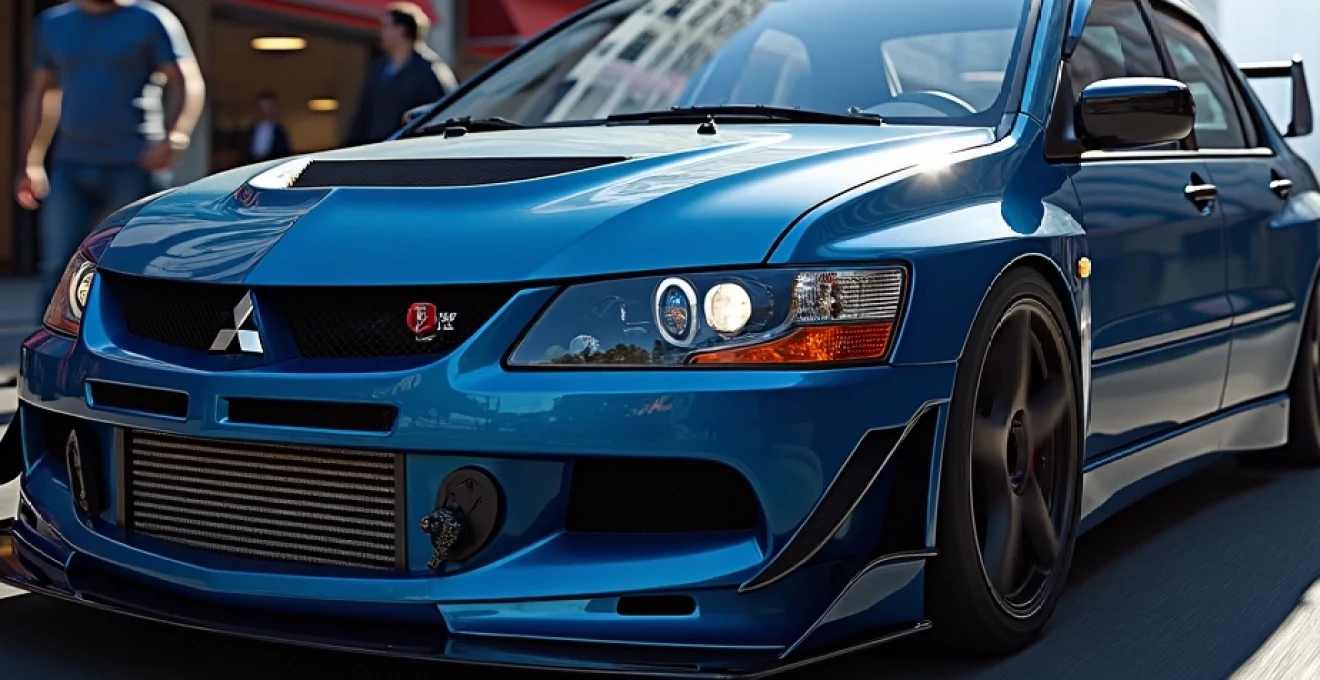
The 2006 Mitsubishi Lancer Evolution IX represents the pinnacle of Japanese rally-bred engineering, marking the final iteration of the legendary fourth-generation Evolution platform before Mitsubishi’s complete redesign. This homologation special emerged from decades of World Rally Championship pedigree, delivering 286 horsepower through sophisticated all-wheel-drive technology that transformed everyday driving dynamics. Beyond its motorsport credentials, the Evolution IX established new benchmarks for turbocharged performance sedans, combining track-focused capabilities with surprising daily usability. Its advanced MIVEC variable valve timing system and refined Super Active Yaw Control represented evolutionary leaps from previous generations, whilst maintaining the raw, uncompromising character that defined the Evolution lineage.
Technical specifications and engineering excellence of the 2006 evo IX
4G63T MIVEC engine architecture and turbocharged performance
The heart of the Evolution IX lies in its legendary 4G63T MIVEC powerplant, a 2.0-litre turbocharged inline-four engine that traces its lineage back to the 1970s whilst incorporating thoroughly modern technology. This cast-iron block architecture features dual overhead camshafts, sixteen valves, and sequential fuel injection, producing 286 horsepower at 6,500 rpm alongside 289 lb-ft of torque at 3,500 rpm. The engine’s robust construction allows for significant power modifications, making it a favourite amongst tuning enthusiasts worldwide.
Engineers enhanced the combustion chamber design with longer-threaded spark plugs for improved heat dissipation and revised oil ring configurations to reduce consumption. The timing belt received material upgrades for enhanced durability, whilst a heat-resistant engine cover provides better thermal management. These refinements contribute to the engine’s remarkable reliability under high-stress conditions, whether on track days or spirited road driving.
MIVEC variable valve timing system operation and benefits
Mitsubishi’s MIVEC (Mitsubishi Innovative Valve timing Electronic Control) system represents a significant advancement over previous Evolution generations, optimising intake valve timing across the entire rev range. The system adjusts cam timing based on engine load, throttle position, and RPM, delivering improved low-end torque whilst maintaining high-rpm performance characteristics. This technology virtually eliminates the traditional turbo lag associated with high-performance forced induction engines.
During low-RPM operation, MIVEC advances intake valve timing to improve combustion efficiency and torque delivery, particularly beneficial for urban driving conditions. As engine speed increases, the system retards timing to maximise peak power output. This dual-phase approach ensures the Evolution IX delivers progressive power delivery rather than the abrupt power band transitions common in earlier turbocharged applications.
Mitsubishi TD05HR-16G6 turbocharger configuration
The Evolution IX employs a sophisticated TD05HR-16G6 turbocharger featuring a larger, more direct compressor housing outlet that reduces turbo lag by approximately five percent compared to previous generations. This unit generates maximum boost pressure of 20.2 psi, delivering forced induction across a remarkably wide RPM band. The turbocharger’s ball-bearing construction reduces friction and improves response times, contributing to the engine’s explosive mid-range acceleration.
Engineers positioned the turbocharger for optimal heat management and accessibility, with dedicated oil and coolant lines ensuring consistent operating temperatures during extended high-performance driving. The wastegate control system precisely regulates boost pressure, preventing over-boost conditions whilst maintaining consistent power delivery across varying atmospheric conditions. This attention to thermal management explains why the Evolution IX maintains performance consistency during track sessions where other turbocharged vehicles might experience heat soak.
Intercooler design and heat management systems
The front-mounted intercooler system efficiently reduces intake air temperatures, maximising power output whilst preventing detonation under high boost conditions. The intercooler’s aluminium construction provides excellent heat dissipation, with strategically positioned ducting directing airflow for optimal cooling efficiency. This system proves particularly effective during sustained high-speed driving, maintaining consistent power delivery where less sophisticated cooling systems might cause performance degradation.
Additional heat management features include revised radiator ducting and improved coolant circulation pathways. The engine bay design prioritises airflow management, with heat shields protecting sensitive components from exhaust temperatures. These thermal considerations demonstrate Mitsubishi’s rally-derived engineering approach, where consistent performance under extreme conditions takes precedence over aesthetic concerns.
All-wheel drive dynamics: active yaw control and super AYC
Active centre differential electronic control unit programming
The Evolution IX’s all-wheel-drive system centres around an electronically controlled centre differential that continuously monitors driving conditions and adjusts torque distribution accordingly. This sophisticated system processes inputs from wheel speed sensors, steering angle, throttle position, and lateral acceleration to determine optimal power allocation between front and rear axles. The centre differential can vary from a 50:50 split to directing up to 98% of available torque to either axle, depending on traction requirements.
Three distinct driving modes—Tarmac, Gravel, and Snow—provide preset calibrations optimised for different surface conditions. Each mode alters the centre differential’s response characteristics, anti-lock braking sensitivity, and traction control intervention levels. Professional drivers often prefer the Tarmac mode for its aggressive torque transfer characteristics, whilst the Snow mode provides gentler power delivery for challenging weather conditions.
Super active yaw control rear differential mechanics
The rear axle incorporates Mitsubishi’s advanced Super Active Yaw Control (S-AYC) system, an electronically controlled limited-slip differential that actively manages torque distribution between rear wheels. Unlike passive mechanical differentials, S-AYC can transfer torque to the outside rear wheel during cornering, effectively pulling the vehicle through turns rather than simply preventing wheelspin. This system dramatically improves cornering speeds whilst maintaining stability and driver confidence.
S-AYC operation involves a planetary gear set controlled by an electromagnetic clutch system. During cornering, the system calculates the optimal torque split based on steering input, vehicle speed, and lateral G-forces. The result is enhanced cornering agility that allows drivers to maintain higher speeds through technical sections whilst reducing understeer tendencies common in all-wheel-drive vehicles.
Tarmac, gravel, and snow drive mode calibrations
Each drive mode represents carefully calibrated responses tailored to specific surface conditions and driving styles. Tarmac mode provides the most aggressive settings, with minimal electronic intervention and rapid torque transfer responses optimised for dry pavement conditions. The centre differential bias favours the rear axle under acceleration, promoting the characteristic tail-happy behaviour that rally drivers exploit for rapid direction changes.
Gravel mode moderates the system’s responses, allowing for controlled slides whilst maintaining overall stability. This mode proves invaluable on loose surfaces where maintaining momentum through controlled oversteer becomes advantageous. Snow mode prioritises traction and stability, with gentler power delivery and increased electronic intervention to prevent loss of control on slippery surfaces.
Torque vectoring algorithm implementation
The Evolution IX’s torque vectoring capabilities extend beyond simple differential locking, actively managing individual wheel speeds to enhance cornering performance. The system continuously calculates optimal torque distribution based on real-time sensor inputs, adjusting power delivery within milliseconds of detecting changing conditions. This rapid response capability allows the vehicle to maintain optimal trajectories even when surface conditions vary mid-corner.
Advanced algorithms predict vehicle behaviour based on current inputs, pre-emptively adjusting torque distribution to maintain the driver’s intended path. This predictive capability distinguishes the Evolution IX from reactive systems that only respond after detecting problems. The result is a vehicle that feels telepathically connected to driver inputs, responding to steering corrections before the driver consciously recognises the need for adjustment.
Chassis engineering: bilstein dampers and eibach springs setup
The Evolution IX MR variant features premium Bilstein monotube dampers paired with Eibach springs, creating a suspension system that balances track-focused performance with reasonable road comfort. These components represent significant upgrades from standard Evolution IX suspension, offering improved damping control and reduced weight compared to conventional twin-tube designs. The monotube construction provides consistent performance during extended high-performance driving, maintaining damping characteristics even under extreme thermal conditions.
Spring rates are carefully calibrated to complement the dampers’ characteristics, providing controlled body movements without compromising wheel contact. The suspension geometry incorporates rally-derived principles, with optimised camber curves and anti-squat characteristics that maintain stability during hard acceleration and braking. Anti-roll bars front and rear provide additional body control whilst allowing individual wheel movement over uneven surfaces.
The chassis itself features strategically placed reinforcements to handle the increased power and dynamic loads. Additional bracing around the strut towers and underbody strengthens the structure whilst maintaining reasonable weight distribution. These modifications create a platform capable of exploiting the drivetrain’s full potential without introducing unwanted flex or vibration. Professional drivers often comment on the chassis’s exceptional rigidity and predictable behaviour at the limit, characteristics that inspire confidence during aggressive driving.
The Evolution IX’s chassis represents the perfect balance between compliance and control, allowing drivers to exploit maximum performance whilst maintaining comfort during daily driving conditions.
Brembo braking system and OZ racing wheel package
High-performance Brembo brakes provide the stopping power necessary to match the Evolution IX’s acceleration capabilities, featuring ventilated discs and multi-piston callipers designed for consistent performance under extreme conditions. The front system utilises four-piston fixed callipers gripping 320mm ventilated rotors, whilst the rear features solid discs with sliding callipers. This configuration provides excellent pedal feel and fade resistance during track use, with initial grabbiness giving way to progressive, linear response as temperatures increase.
The brake system’s thermal management impresses experienced drivers, maintaining consistent pedal feel and stopping distances throughout extended high-performance sessions. Heat dissipation proves particularly effective, with strategically designed cooling ducts directing airflow to critical components. The ABS system integrates seamlessly with the all-wheel-drive system, preventing wheel lockup whilst maintaining directional stability even on mixed-surface conditions.
Lightweight forged wheels reduce unsprung weight whilst providing the strength necessary for high-performance applications. The Evolution IX typically features 17-inch diameter wheels with carefully selected offset and width specifications that optimise suspension geometry and brake cooling. Tyre options range from high-performance street compounds to dedicated track tyres, each offering different characteristics suited to various driving conditions and preferences.
Interior technology: recaro seats and MOMO steering wheel integration
The Evolution IX’s interior balances functional performance requirements with reasonable comfort and usability for daily driving. Recaro bucket seats provide exceptional lateral support during cornering whilst maintaining comfort during extended drives, featuring Alcantara and leather upholstery that combines durability with premium aesthetics. The seats’ aggressive bolstering holds occupants securely without feeling restrictive, crucial for maintaining proper driving position during spirited driving sessions.
A leather-wrapped MOMO steering wheel features a diameter and grip thickness optimised for precise control inputs, with strategically placed thumb rests that enhance driver connection. The wheel’s weighting provides excellent feedback from the front wheels, communicating surface conditions and grip levels directly to the driver’s hands. This tactile feedback proves invaluable when exploring the vehicle’s limits, allowing experienced drivers to detect approaching breakaway conditions before they become problematic.
Instrumentation focuses on essential information delivery, with clear, easily readable gauges providing engine vitals and performance data. Additional gauges monitor boost pressure and other critical parameters, allowing drivers to monitor engine conditions during high-performance driving. The overall interior design prioritises function over form, with controls positioned for easy access without requiring drivers to remove their hands from the steering wheel during dynamic driving situations.
Climate control and other comfort features ensure the Evolution IX remains usable for daily transportation despite its performance focus. The integration of practical elements with track-focused components demonstrates Mitsubishi’s understanding that most owners require a vehicle capable of serving multiple roles. Storage solutions and ergonomic considerations accommodate the realities of daily use whilst maintaining the focused driving environment that performance enthusiasts demand.
Market variants: evolution IX MR vs standard model differences
The Evolution IX lineup offers multiple variants catering to different performance priorities and budgets, with the MR (Mitsubishi Racing) representing the range-topping specification. Standard Evolution IX models provide exceptional performance value, featuring the full drivetrain and suspension systems that define the Evolution experience. These variants typically include five-speed manual transmissions, standard suspension components, and comprehensive equipment levels suitable for both performance driving and daily use.
Evolution IX MR models incorporate premium upgrades that enhance both performance and refinement, including the six-speed manual transmission with closer gear ratios optimised for track use. The Bilstein suspension system provides superior damping characteristics compared to standard components, whilst lightweight forged wheels reduce unsprung weight for improved handling response. Additional refinements include enhanced interior trim materials and exclusive paint options that distinguish MR variants from standard models.
The stripped-down RS variant appeals to serious enthusiasts and track-focused buyers, eliminating non-essential equipment to reduce weight and cost. These models typically delete air conditioning, premium audio systems, and other comfort features whilst retaining all performance-critical components. The RS philosophy prioritises pure driving experience over luxury appointments, creating the lightest and most focused Evolution IX variant available.
Each Evolution IX variant serves specific buyer preferences, from the luxury-oriented MR to the track-focused RS, ensuring the Evolution IX appeals to the broadest possible enthusiast market whilst maintaining uncompromised performance credentials.
Current market values for Evolution IX models reflect their status as the final iteration of the classic Evolution formula, with pristine examples commanding premium prices that continue appreciating. Clean, unmodified examples with comprehensive service histories represent increasingly rare finds in today’s marketplace, particularly MR variants with their enhanced specifications and limited production numbers. The Evolution IX’s combination of modern performance technology with analogue driving characteristics creates a unique proposition that newer vehicles struggle to replicate, explaining their strong collector appeal and investment potential in the modern automotive landscape.